
15 best brand tracking tools for 2026 (pricing & pitfalls)
Strong brands beat the S&P 500 by 82 points over 20 years. Here's how to pick brand tracking software that actually proves your ROI.
McKinsey ranked branding the #1 marketing priority for 2026 among 500 senior marketing leaders, and Kantar's BrandZ analysis found its portfolio of strong brands returned 435% over 20 years, versus 353% for the S&P 500. Brand perception isn't a soft metric anymore; it's a real predictor of financial performance.
Brand tracking software exists to close the gap between "we ran a campaign" and "we know it worked."
This guide covers what brand tracking software is, the metrics and features that matter, a curated list of the 15 best monitoring and social listening tools (with pricing and limitations), and a blind spot most stacks still miss: Reddit.
What is brand tracking software?
Brand tracking software continuously measures how a brand is perceived across audiences, channels, and time. That word "continuously" is what separates it from a one-off brand audit.
In practice, "brand tracking" and "brand monitoring" get used interchangeably, and for this guide, that's fine: both describe the same continuous, real-time approach to measuring brand perception. The more useful distinction is between that continuous approach and simple keyword-level social listening.
As brand tracking platform Timelaps puts it:
“A basic listening tool can tell you 10,000 people posted about your rebrand, but it can't tell you whether the 100 million who didn't post now think better or worse of you.”
Key metrics and features brand tracking software should deliver
Know what you're trying to measure before you shop for a tool, and which features actually deliver it:
- Brand awareness and recall: Unaided recall (naming your brand with no prompt) predicts purchase consideration better than aided recognition, per Iconic Research. It only means something with real historical data; 30 days of lookback won't tell you what's normal for your brand.
- Sentiment: Trend lines matter more than any single snapshot. Quality depends on how well the engine handles sarcasm and context, not just keyword flagging, and on speed: a delayed read on an unfolding reputation event defeats the purpose.
- Share of Voice (SoV): How often your brand comes up relative to competitors. The Ehrenberg-Bass Institute's Excess Share of Voice research (via Les Binet and Peter Field) found 10 points of ESOV correlates with roughly 0.5% annual market share growth, though the principle draws some academic pushback. SoV is meaningless without competitive benchmarking built in, since a dip might just be a category-wide trend.
- Consideration and purchase intent: The gap between knowing a brand and choosing it is where tracking earns its keep, and it's rarely uniform across audiences. Audience filtering and segmentation reveals what a single blended number hides.
- NPS and loyalty signals: Bain research finds NPS explains 20–60% of the variation in organic growth between competitors, though academics have challenged its reliability as a universal predictor. Signals only matter if your team sees them: alerting determines whether you learn about a shift in real time or three weeks late in a quarterly review.
The 15 best brand tracking software tools
1. Meltwater
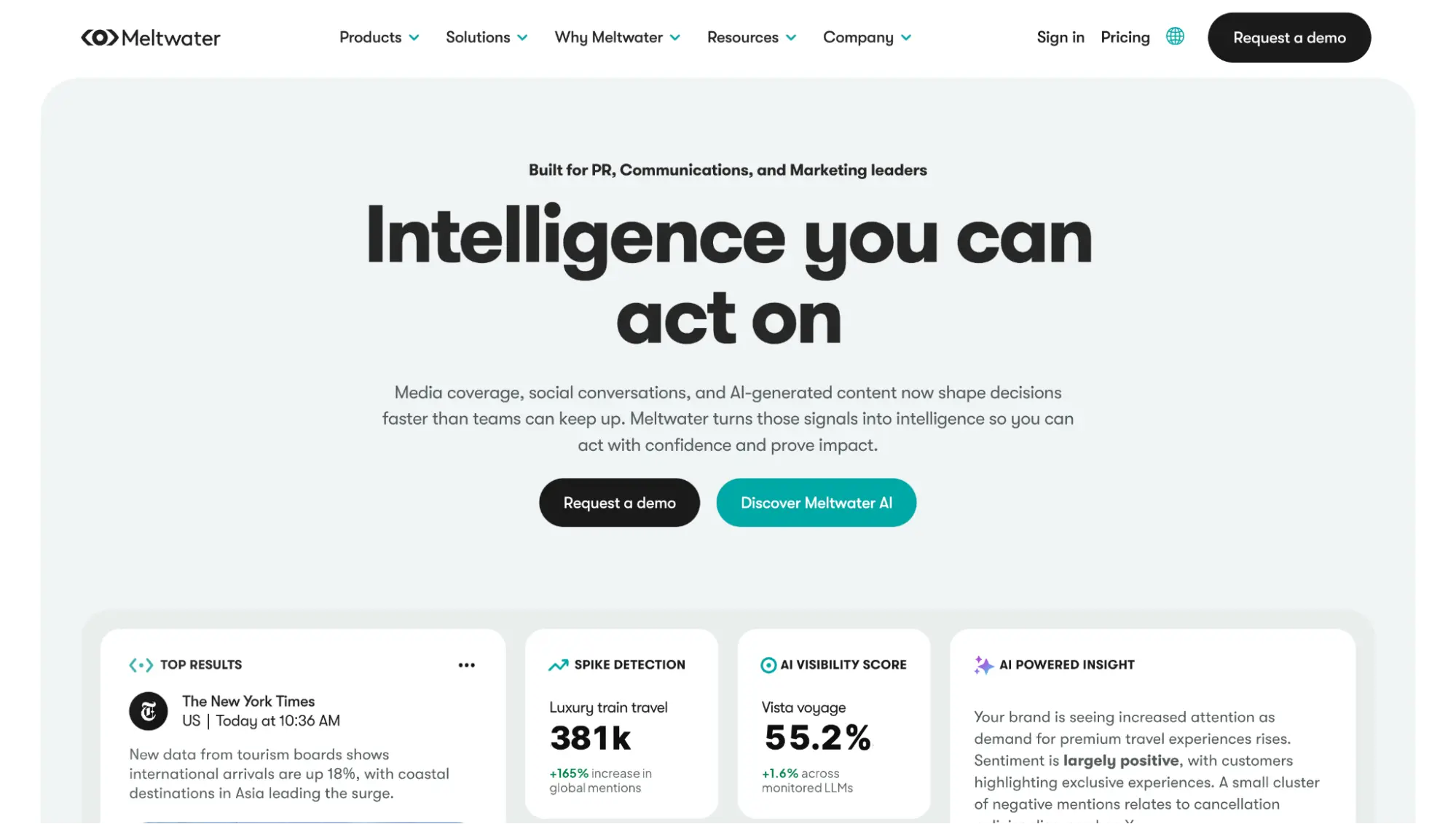
Meltwater is one of the oldest media intelligence and social analytics platforms, monitoring millions of media sources plus social channels for PR, communications, and marketing teams.
However, contract and renewal practices are the standout red flag. Per Meltwater's own Help Center, contracts auto-renew for a full additional term at Meltwater's then-standard price unless canceled at least 60 days before the term ends. Across G2, Trustpilot, and TrustRadius, users repeatedly report being locked into another full year after narrowly missing that cutoff.
Best for: Enterprise PR and communications teams needing broad global media monitoring across news, print, broadcast, podcasts, and social, with the budget and headcount to use it fully.
Pricing: No public pricing; annual contracts only, no monthly option. Vendr's procurement data puts the median around $25,000/year, with mid-tier deployments commonly $15,000–$20,000 and enterprise deployments reaching $100,000-plus; basic single-user monitoring has been reported around $6,000–$7,000/year.
Limitations: Auto-renewing contracts with a 60-day cancellation window and hard-sell sales tactics are the dominant complaint. Users also report the platform misses content from active campaigns, surfaces irrelevant "noise," and charges extra for each new market or keyword added.
2. Threadlytics
Threadlytics is a Reddit brand tracking platform, drawing on more than four billion indexed conversations, with real-time sentiment analysis, Share of Voice analysis, and opportunity scoring. Because it's built specifically for Reddit's community structure, it enables subreddit-level filtering, context-aware keyword monitoring, and SERP tracking for Reddit's rankings in Google, capabilities that no general social listening tool replicates.
Best for: Brands and agencies that have identified Reddit as a gap in their existing stack, whether that's a general monitoring tool with weak Reddit coverage (see Brand24, Mention, and Awario above) or no Reddit coverage at all, and want dedicated, subreddit-level intelligence rather than a bolt-on feature.
Pricing: Public tiers, billed monthly (per Threadlytics' pricing page): Standard $99/mo (20 keywords, 5,000 mentions, 1 user, hourly alerts), Pro $199/mo (100 keywords, 20,000 mentions, 5 users, 15-minute alerts, adds account tracking and SERP tracking), Premium $499/mo (250 keywords, 50,000 mentions, 10 users, 5-minute alerts), and a custom Enterprise tier with API access, unlimited users, and deeper historical data. A 7-day free trial is available.
3. Onclusive Social (formerly Digimind)
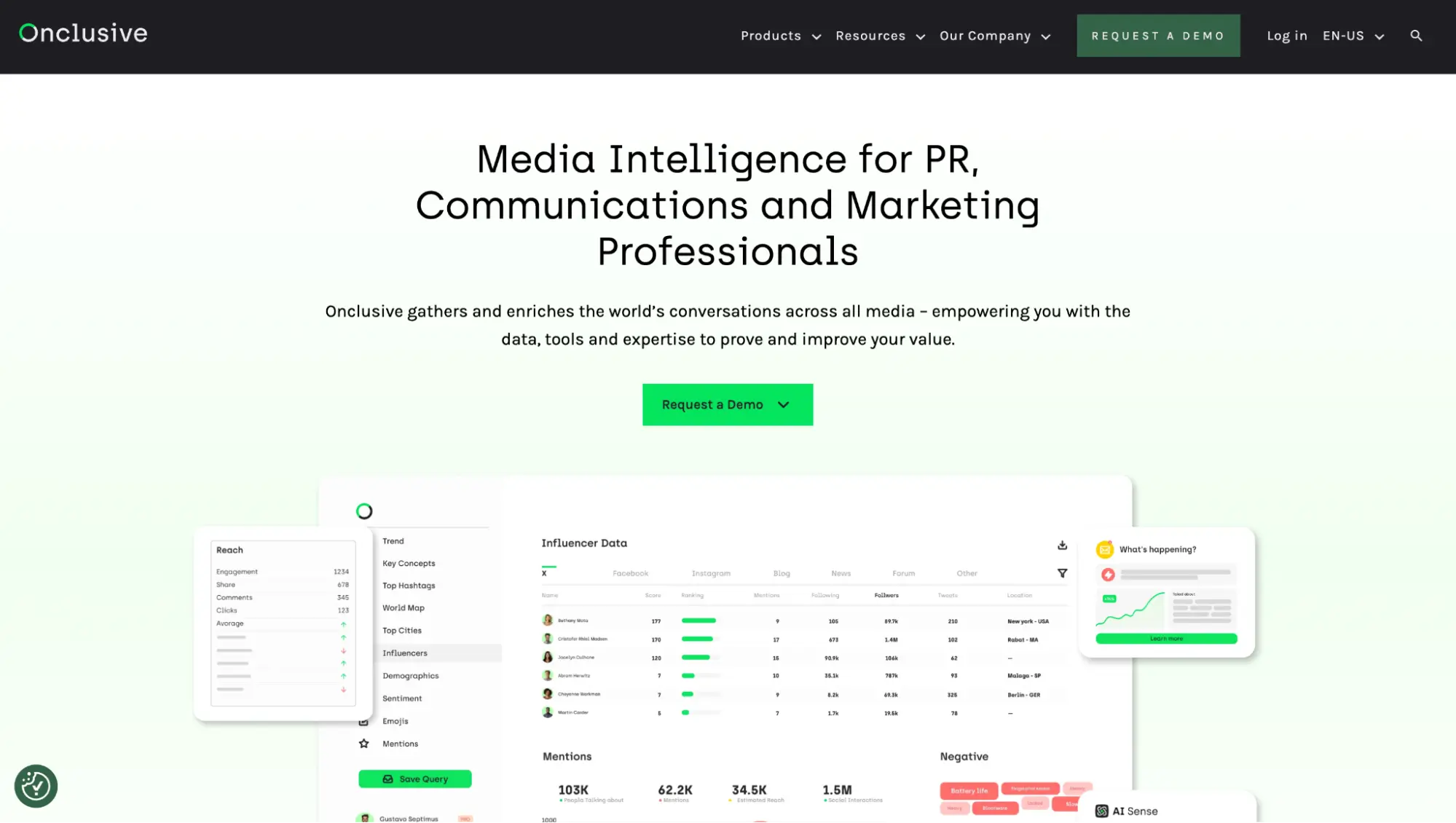
Onclusive Social pairs social listening with traditional media monitoring in one platform, and is one of the few tools in this category with LinkedIn monitoring.
That said, G2 reviewers describe queries as "difficult to set up" and the platform as "not very easy to use," and the payback period is brutal: G2's own ROI data shows roughly 1 month to implement but 17 months to see ROI. Capterra reviewers also flag data collection gaps, including missing Instagram Stories, Facebook Groups, and IGTV content.
Best for: Mid-market to enterprise PR and comms teams that need LinkedIn monitoring alongside traditional media coverage, and are willing to invest setup time upfront.
Pricing: No public pricing page, and no third-party procurement data (Vendr, TrustRadius) has verified figures either. G2 reviewers note the lack of published pricing as a recurring frustration during the sales process.
Limitations: Query setup is difficult without vendor hand-holding, and the 17-month average time-to-ROI is long for a mid-tier tool. TikTok coverage exists, but several reviewers call out limited Facebook content and inconsistent historical data availability across sources.
4. YouScan
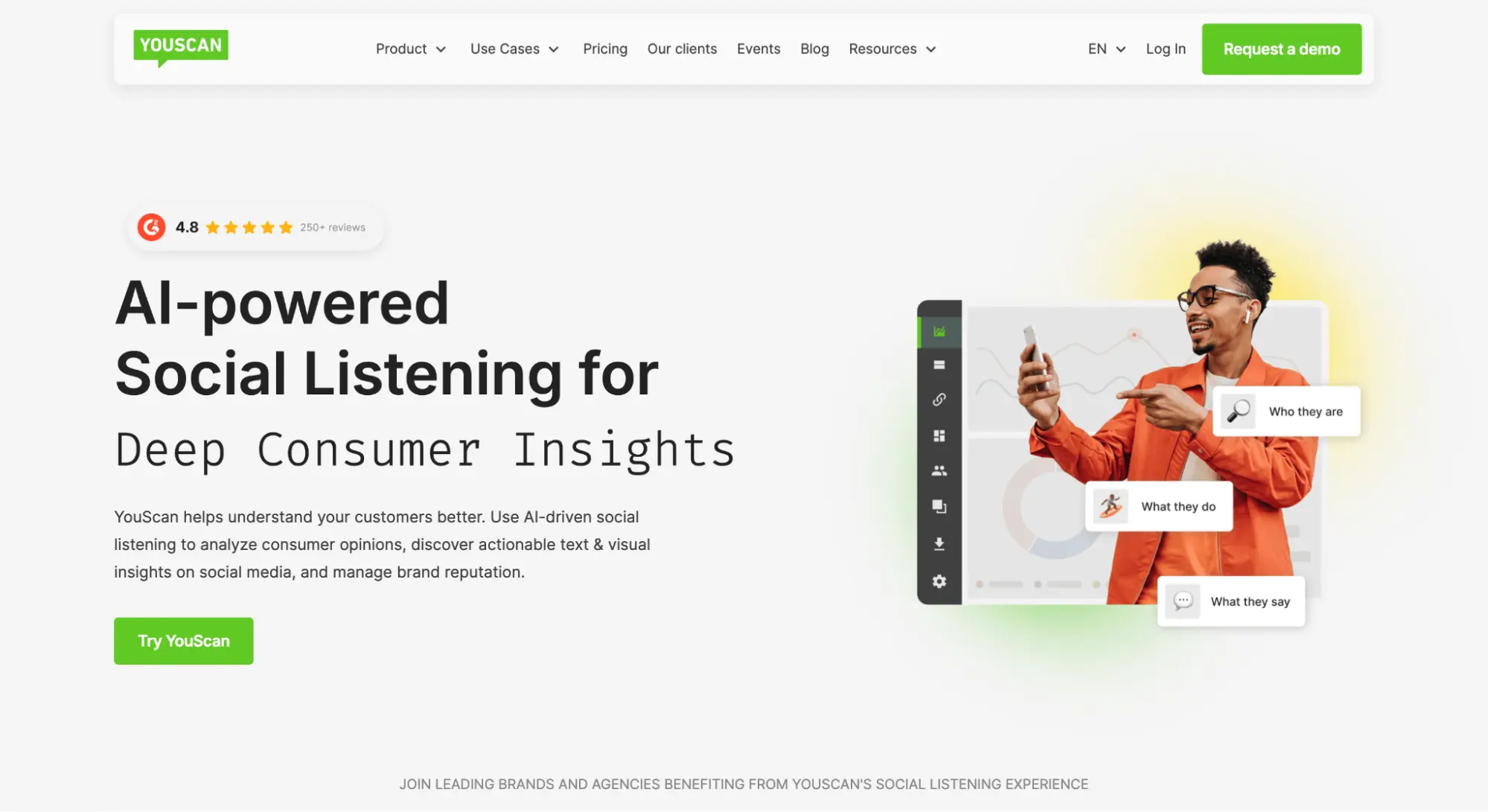
YouScan is an AI-powered social listening platform built around "visual listening," using image recognition to detect logos and brand mentions in photos and video that text-only tools miss, plus a conversational AI agent called Insights Copilot.
Sentiment analysis still needs a human check. G2 reviewers note that "the sentiment analysis doesn't always work correctly" and requires manual review to catch misclassified posts, and the tagging workflow for organizing large datasets is described as fairly manual despite the platform's AI positioning.
Best for: Consumer and lifestyle brands where visual content, like product photos, logos in the wild, or influencer posts, carries as much signal as text mentions.
Pricing: Public and transparent: Starter-3 plan at $499/month (billed annually), with Unlimited plans for larger brands and agencies that add Visual Insights, Audience Insights, unlimited custom dashboards, and API access. Notably cheaper than Brandwatch's $800+/month starting point.
Limitations: Automatic sentiment analysis requires manual review to be reliable, and the tagging process for structured analysis is manual and time-consuming at scale. Some reviewers also note query-building for complex searches is slower than they'd like.
5. Determ (formerly Mediatoolkit)
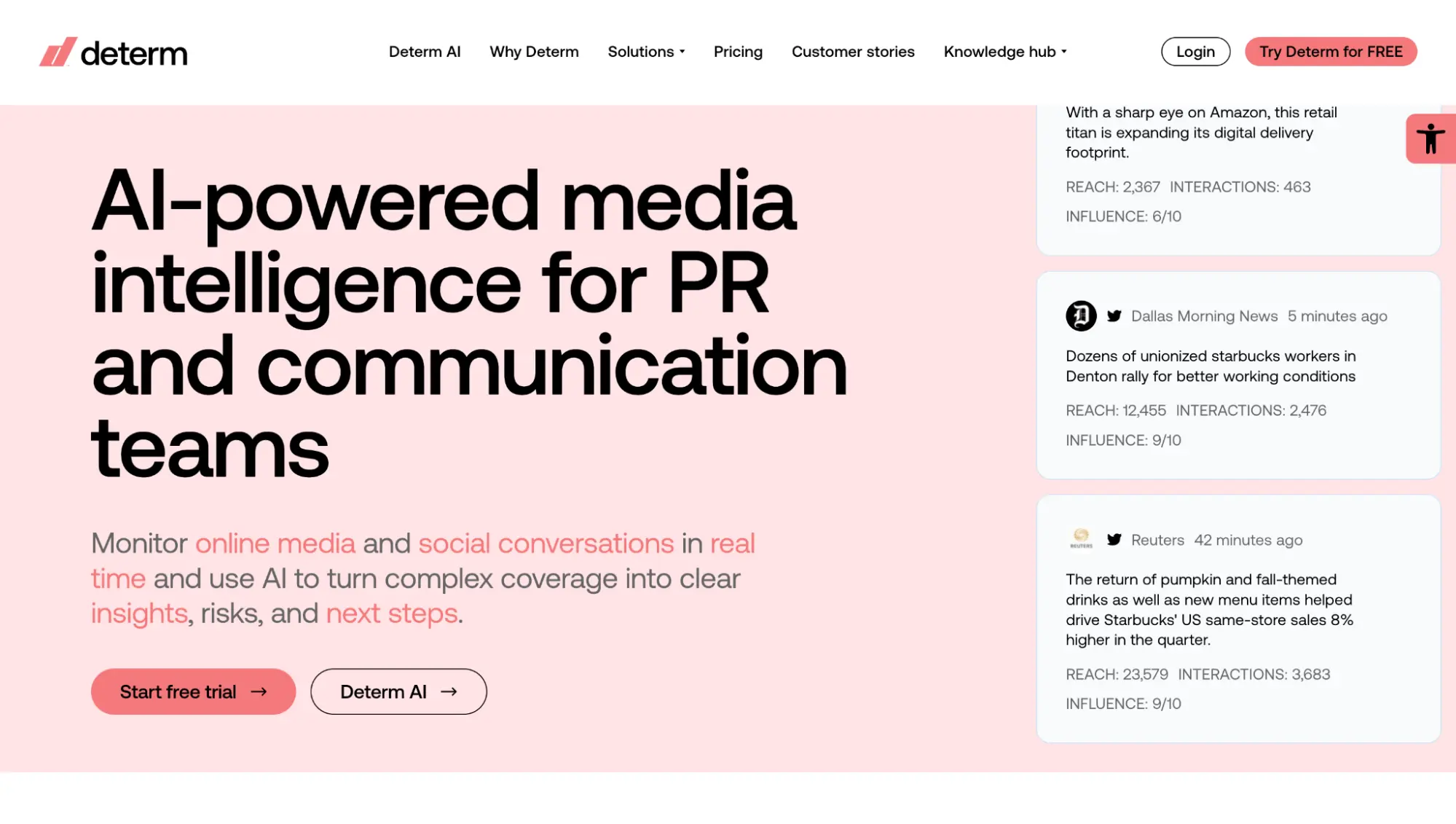
Determ is a media monitoring platform for PR and marketing teams, tracking keywords across more than 100 million sources with an AI assistant (Synthia) that summarizes mentions and drafts response recommendations.
Reddit coverage is a documented weak point despite being a listed source. Independent reviews state that "despite Reddit being listed as a supported source, users report patchy coverage," and Determ has no TikTok monitoring, along with limited Instagram Reels and Stories coverage.
Best for: SMB and mid-market PR teams that want transparent-ish pricing and strong Boolean search for traditional media and web monitoring, and don't need TikTok.
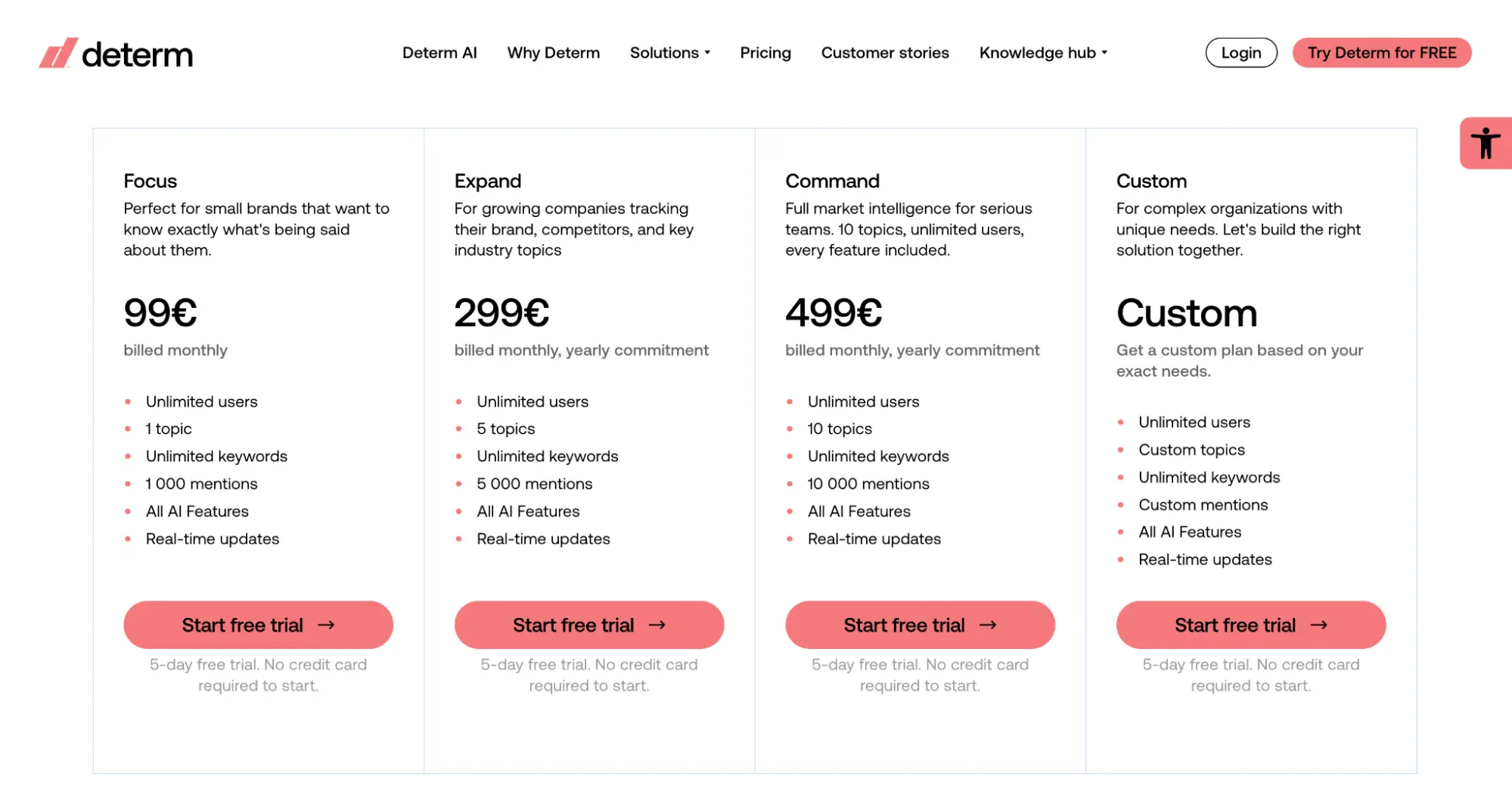
Pricing: Entry tier (Focus) starts around €99/month; higher Command and Custom tiers scale up with no published ceiling. A 5-day free trial is available (14 days if you book a demo).
Limitations: No TikTok monitoring is a real gap for consumer brands, and Reddit coverage, while technically supported, is inconsistent according to user reports. Building effective Boolean queries reportedly takes most teams two to three months to get right.
6. Keyhole
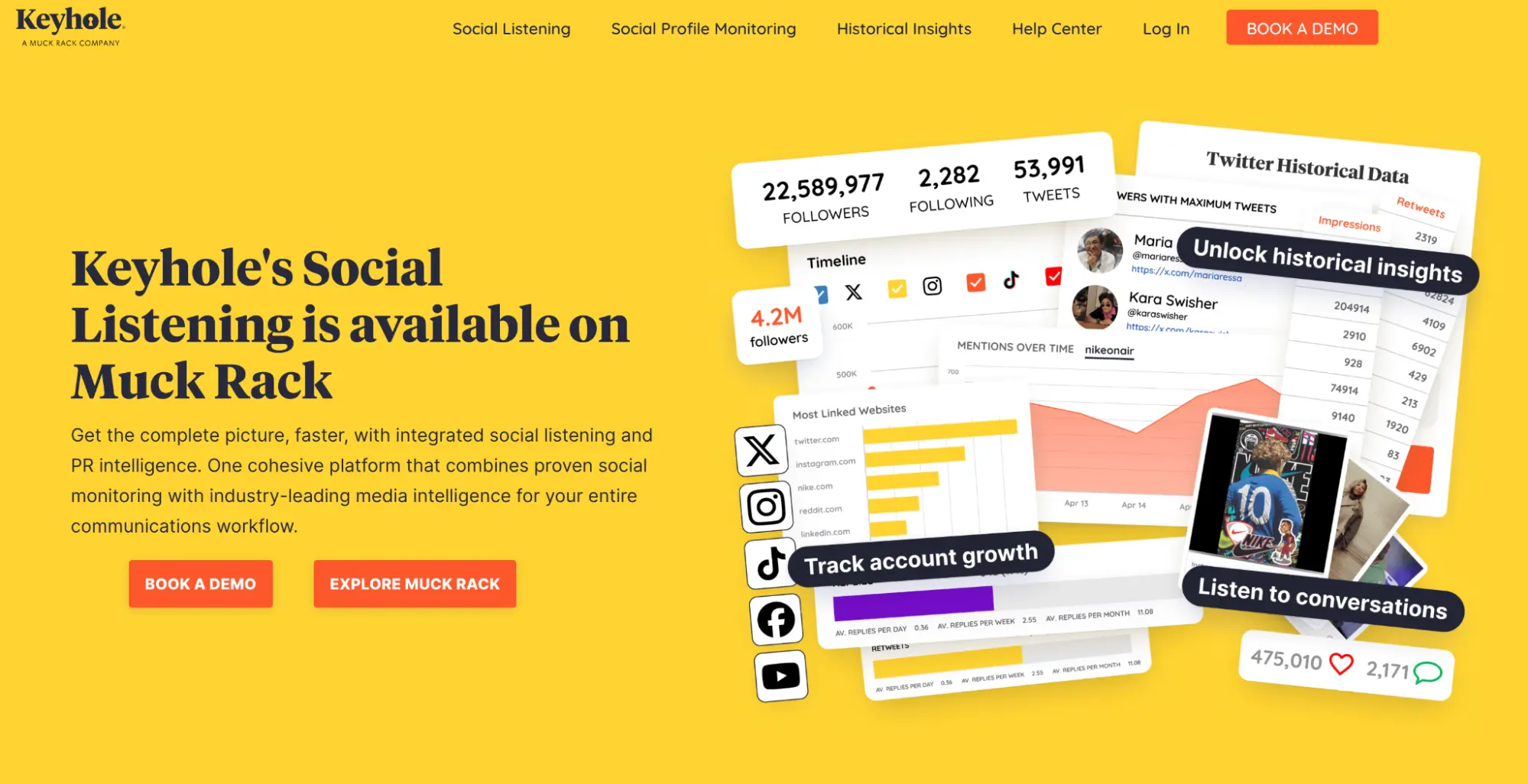
Keyhole, acquired by Muck Rack in 2024, is a social analytics and listening platform built around hashtag tracking, campaign measurement, and influencer identification, with real-time tracking that's useful for live events and campaigns.
It's analytics-only with a narrow platform footprint. Keyhole has no scheduling or publishing functionality, is missing Pinterest and LinkedIn entirely, and the Professional plan's 3 account trackers get consumed fast (your brand plus two competitors fills the quota), forcing an upgrade to Corporate for anything more.
Best for: Agencies and brands running hashtag-driven campaigns or events that need real-time tracking and influencer identification, and already have a separate scheduling tool.
Pricing: No public pricing page, and no third-party procurement data (Vendr, TrustRadius) has verified figures either. G2 reviewers consistently describe it as "a steep price," particularly for a tool focused on hashtag tracking alone.
Limitations: No scheduling or publishing means most teams end up paying for a second tool anyway, pushing real monthly cost well past the sticker price. Missing Pinterest and LinkedIn coverage rules it out for brands active there.
7. Quid
Quid combines social listening with market and consumer intelligence, drawing on a historical archive of more than 400 billion posts and strong natural language processing for slang and emoji.
Capterra reviewers describe accuracy gaps: the scraper "misses a lot of posts from key platforms such as IG and TikTok," sentiment analysis is inconsistent, and the learning curve is steep enough that Gartner reviewers rate it slightly below Brandwatch on ease of use.
Best for: Enterprise market research and consumer insights teams that want deep historical data (years further back than most competitors) and don't mind a multi-week ramp-up.
Pricing: No public pricing page, and no third-party procurement data (Vendr, TrustRadius) has verified figures either. Capterra reviewers consistently describe it as high-cost relative to competitors, and no free trial is offered.
Limitations: High cost, a steep learning curve requiring 4-8 weeks of dedicated training before teams see full value, and Capterra reviewers flag limited data exports and inconsistent sentiment accuracy.
8. Brandwatch
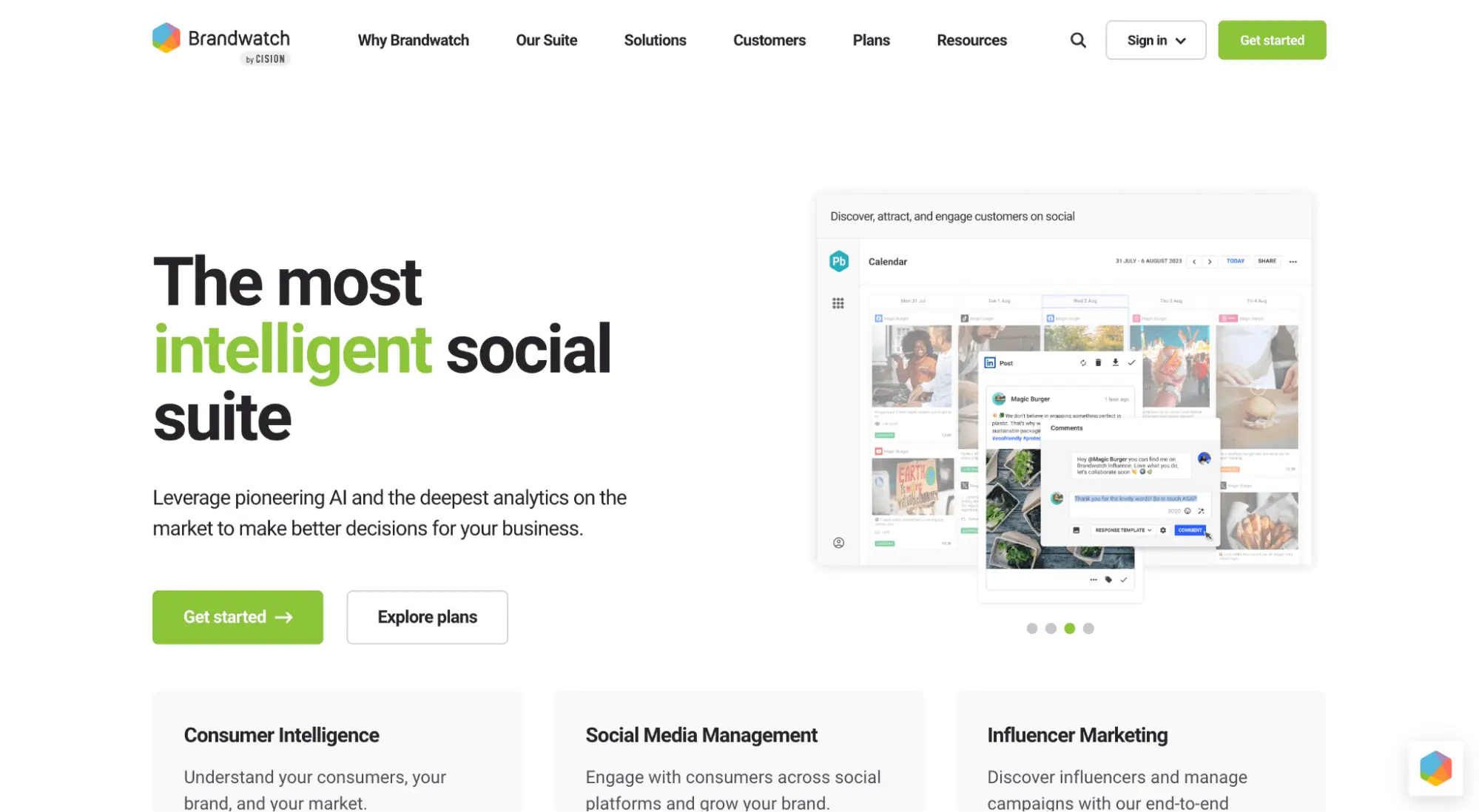
Brandwatch is an enterprise consumer-intelligence and social-listening suite that monitors more than 100 million online sources across 30-plus social networks, with an embedded AI analysis layer and a separate social media management product.
Brandwatch demands dedicated ownership to justify its price. The most consistent complaint across G2 reviews is a steep learning curve; building advanced queries and dashboards is time-consuming, and teams who bought it expecting quick, low-maintenance insights tend to struggle. Reviewers also flag coverage gaps and monthly data caps that hurt ad-hoc project work.
Best for: Large enterprises and research or insights teams with dedicated analysts who need deep consumer research, historical social data, and crisis monitoring, and can manage complex queries.
Pricing: No public pricing; custom annual contracts. Vendr's procurement data puts the median annual contract around $50,000 (with a range roughly $19,500–$81,200, based on 40 purchases).
Limitations: Steep learning curve for query-building and dashboard customization; users report coverage gaps where mentions occasionally don't appear, plus monthly and annual data caps that constrain ad-hoc work. Pricing is opaque and firmly enterprise-level.
9. Sprinklr
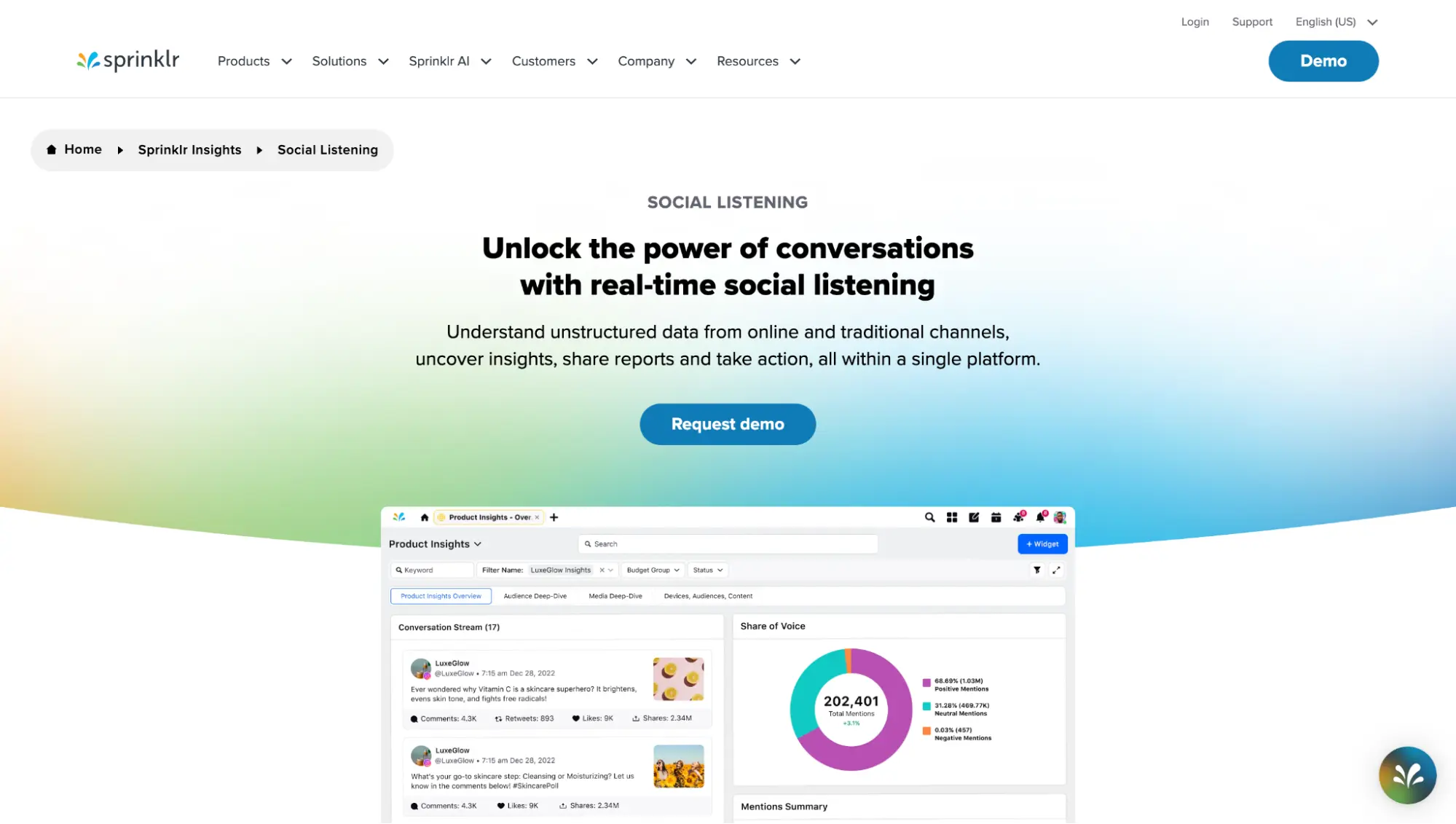
Sprinklr is a large-scale "Unified Customer Experience Management" suite spanning social publishing, customer service, advertising, and its Insights module for real-time listening, sentiment tracking, and market research across 35-plus channels.
Sprinklr shut down its self-serve program entirely as of April 30, 2026, so there's no way to test-drive it without going through enterprise sales, and implementation timelines running 4 to 12 weeks. Reviewers describe it as having the steepest learning curve of any major listening platform, and several note occasional slowness and data discrepancies at scale.
Best for: Large enterprises consolidating three or more social and customer-experience tools into a single platform, with the internal resources to manage a complex system.
Pricing: No public pricing; enterprise sales-only since Sprinklr discontinued self-serve in April 2026.
Limitations: No self-serve tier means every evaluation requires a sales cycle. The learning curve is steep enough that Gartner reviewers describe needing dedicated, technically capable staff just to administer the backend, and smaller teams without that capacity report struggling to get full value.
10. Talkwalker
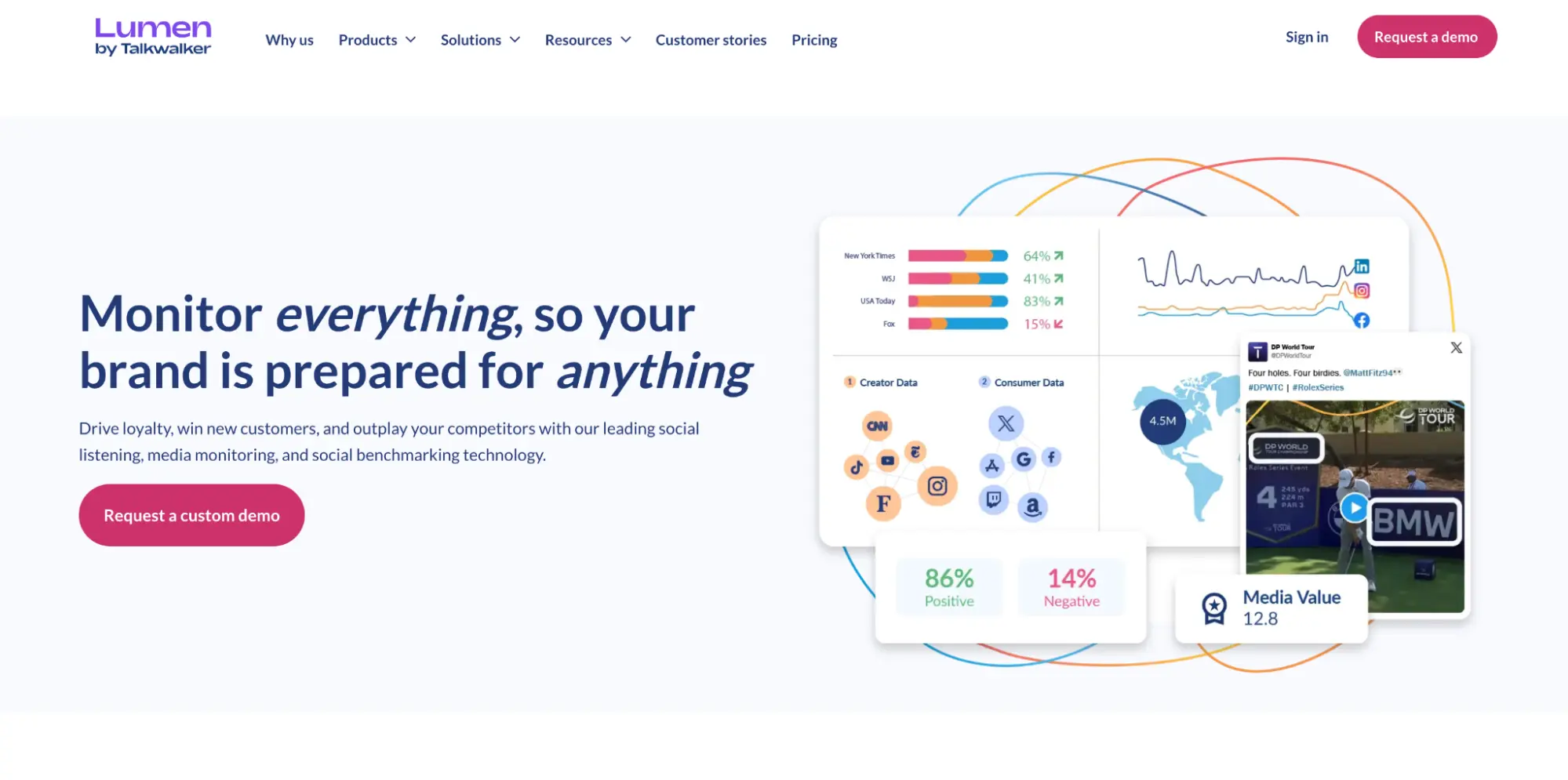
Talkwalker is a consumer-intelligence and social-listening platform pulling from 30-plus social networks and more than 150 million websites, with AI-driven sentiment and emotion analysis across 187 languages, sold on an unlimited-user, data-volume-based model.
However, listening depth on key platforms is a limitation. Capterra reviewers note that "listening is very limited on Facebook and Instagram" because of Meta's API restrictions, that automatic sentiment analysis requires "a lot of manual work to correct," and that there's no analysis of the profiles behind the mentions, making it strong for crisis tracking but weaker for understanding who is talking and why.
Best for: Mid-market to enterprise teams and agencies with large cross-functional groups needing broad social listening, benchmarking, and visual or broadcast recognition at scale.
Pricing: No public pricing; custom, volume-based tiers. Procurement data puts the average around $27,000/year (up to roughly $100,000).
Limitations: Facebook and Instagram listening is limited by Meta's API constraints, and sentiment analysis often needs manual correction. There's a steep learning curve requiring training, and volume-based pricing with no published rates creates a high barrier for smaller teams.
11. Brand24

Brand24 is a social listening and media monitoring tool tracking mentions across more than 25 million sources in over 100 languages, with AI sentiment analysis, automated AI-generated reports, and a newer feature for tracking mentions inside LLM chatbots.
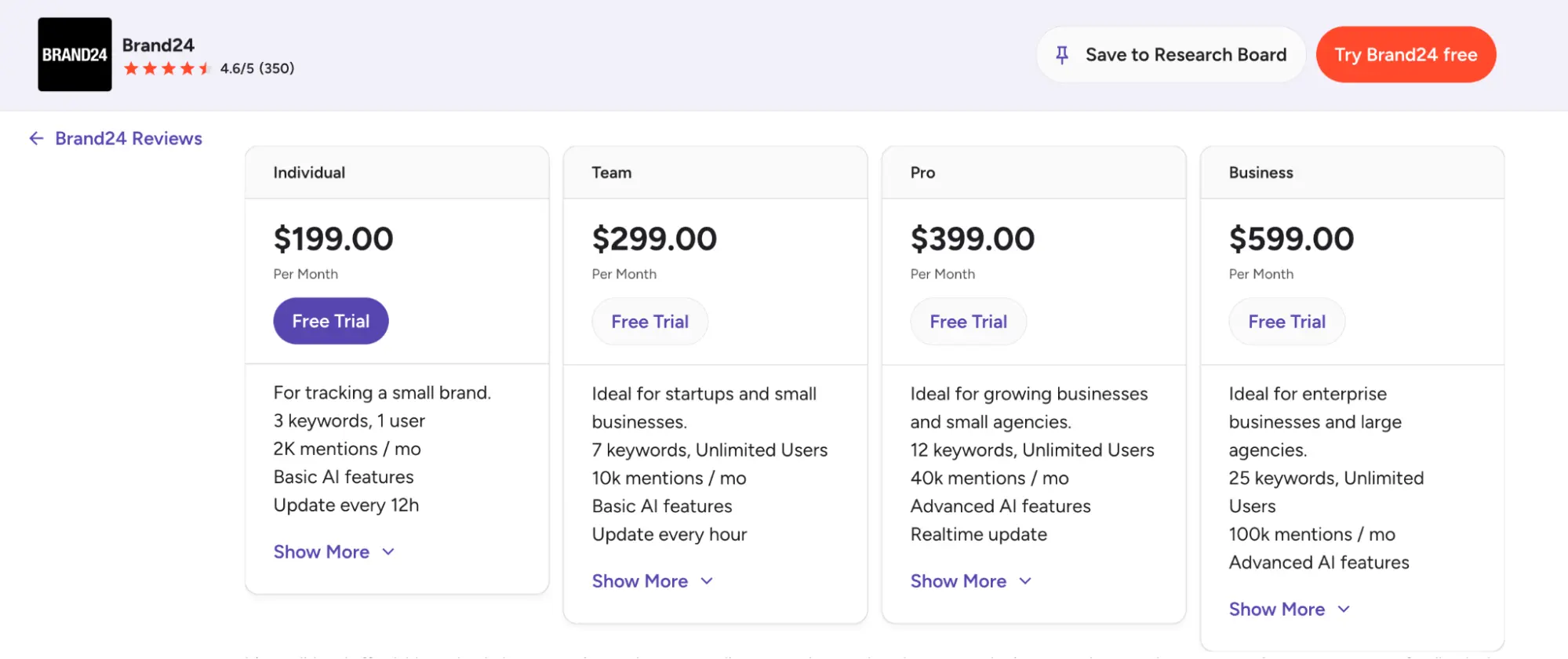
The keyword-limit structure is the concrete, recurring frustration. The entry Individual plan caps you at just 3 keywords and 2,000 mentions per month, with limits applying across all projects combined; reviewers consistently describe hitting keyword walls fast, with one noting that 3 keywords "barely covers your own brand name plus one competitor."
Best for: Small-to-mid-market marketing teams, PR agencies, and brand managers who want broad, affordable real-time monitoring with polished AI reporting and don't need enterprise-scale keyword volumes.
Pricing: Public and transparent (annual billing), per Brand24's G2 pricing profile: Individual $199/mo (3 keywords, 2,000 mentions), Team $299/mo (7 keywords, 10,000 mentions), Pro $399/mo (12 keywords, 40,000 mentions), Business $599/mo (25 keywords, 100,000 mentions), Enterprise from $1,499/mo. A 14-day free trial is available, no credit card required.
Limitations: Keyword caps are tight at every tier and shared across projects, effectively forcing upgrades. The Individual plan is single-user with update delays and misses some newer platforms. Reviewers also cite limited historical data (12 months) and sentiment accuracy issues on non-English or nuanced content.
12. Mention (now Agorapulse)
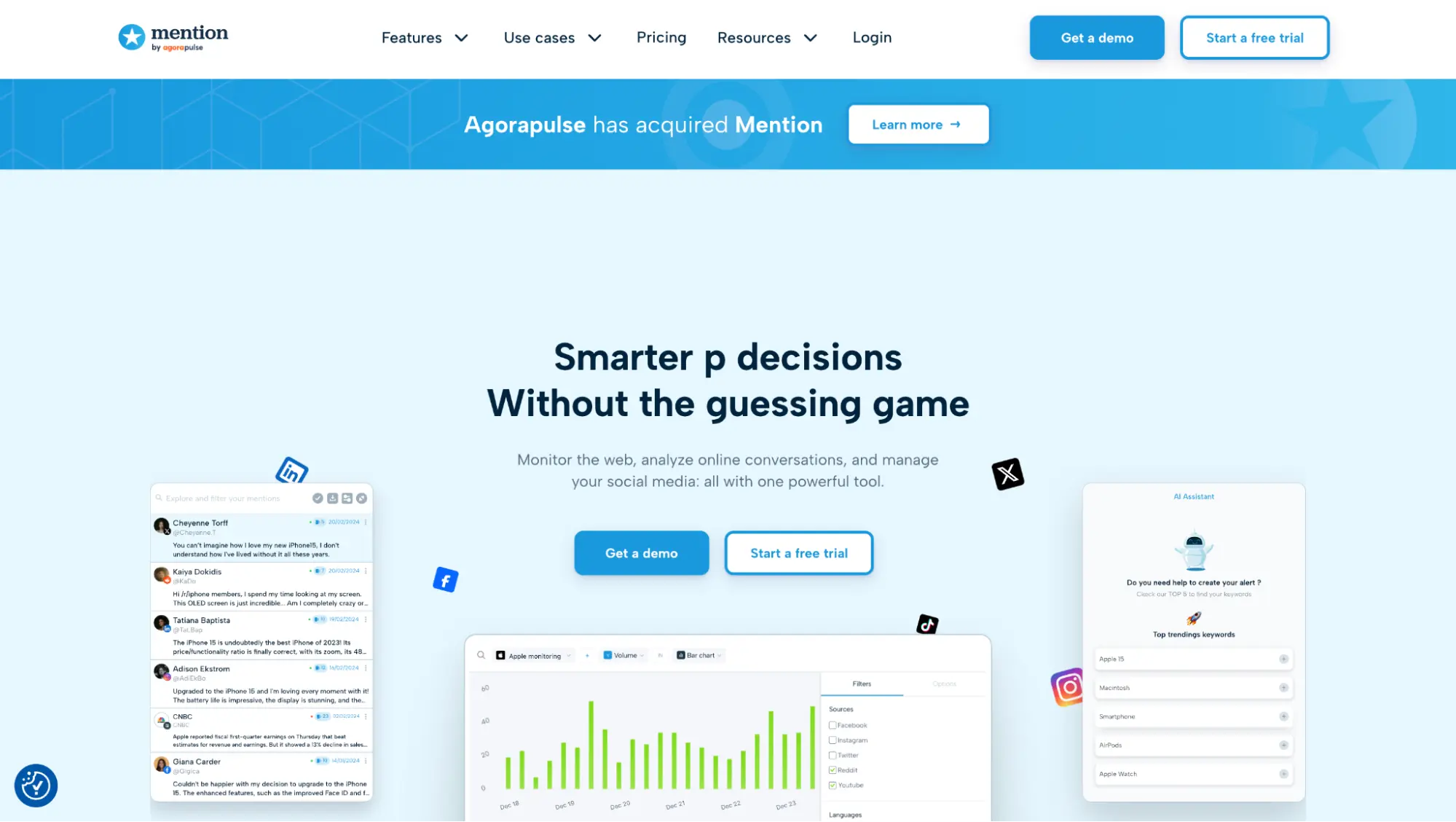
Mention was acquired by Agorapulse, and signing up today lands you directly in Agorapulse's platform, an all-in-one social media management tool handling publishing, inbox management, reporting, and social listening across major platforms.
Reddit monitoring remains a weak point despite Agorapulse launching a dedicated Reddit listening source in mid-2025. Independent analysis notes Agorapulse's own documentation lists targeting specific subreddits as a limitation, and reviewers position it as not specialized enough for precise Reddit keyword alerts or competitor monitoring.
Best for: Teams that prioritize social media publishing and engagement management over deep monitoring, and can accept surface-level Reddit and listening coverage.
Pricing: Agorapulse's pricing page lists paid plans starting at $79/user/month (Standard, billed annually), with Professional at $119, Advanced at $149, and a Custom/Enterprise tier above that. Month-to-month billing runs higher. Advanced Listening is a paid add-on, and a 30-day free trial is available with no credit card required.
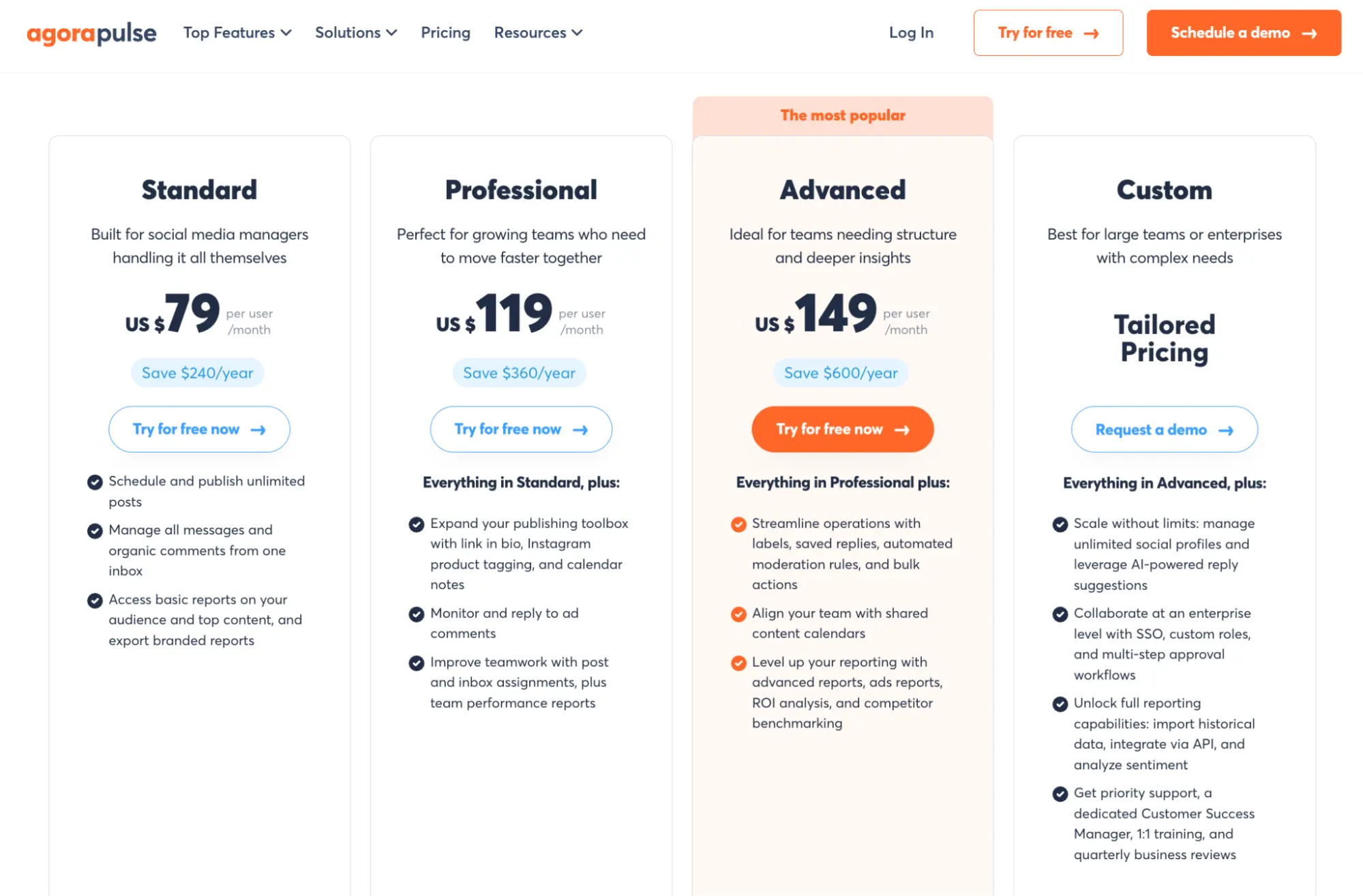
Limitations: Listening is a secondary feature; Reddit monitoring can't reliably target specific subreddits, per Agorapulse's own documentation, and the tool isn't specialized for precise keyword or competitor Reddit alerts. Per-user pricing scales expensively for larger teams.
13. Awario
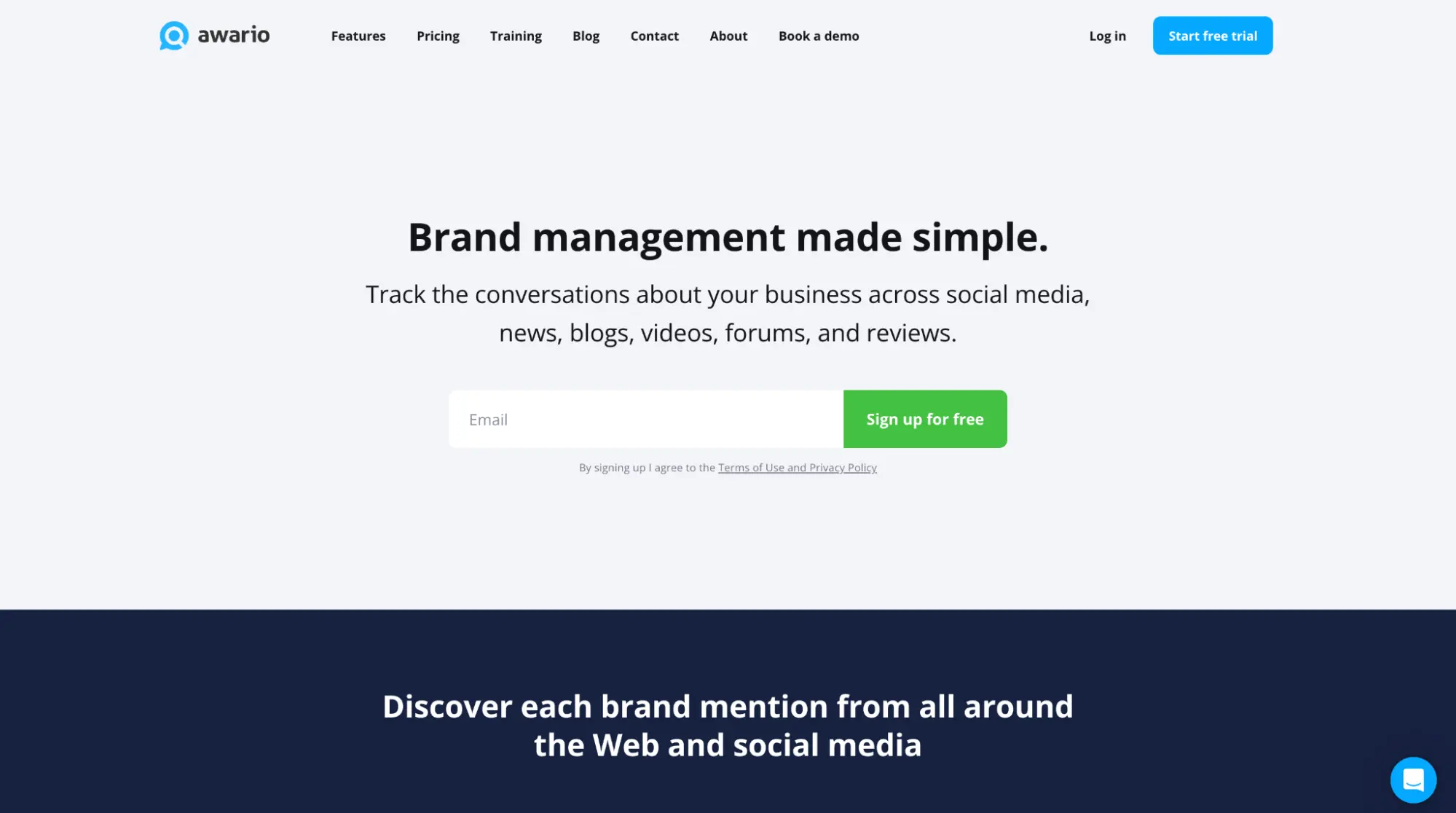
Awario is a mid-market social listening tool that monitors brand mentions across social networks, news, blogs, and the web, notable for strong Boolean search, a buying-intent "Leads" module, and publicly listed pricing in a category where most competitors hide it.
Mention caps and coverage gaps are the biggest constraints. Mention limits fill fast (the Starter plan caps at 30,000 new mentions per month, and hitting a per-alert cap pauses collection for 24 hours), sentiment analysis isn't reliable enough for fine-grained voice-of-customer work without manual review, and reviewers flag that TikTok coverage is missing entirely.
Best for: Budget-conscious small businesses, solo marketers, and agencies that need affordable, forward-looking monitoring plus intent and lead discovery, and can handle the interpretation layer themselves.
Pricing: Public tiers, annual billing, per Awario's pricing page: Starter $29/mo (3 topics, 30,000 mentions, 1 user), Pro $89/mo (15 topics, 300,000 mentions, 10 users), Enterprise $249/mo (100 topics, 1M mentions, unlimited users, API access). Monthly billing runs higher. A 7-day free trial is available, no credit card required.
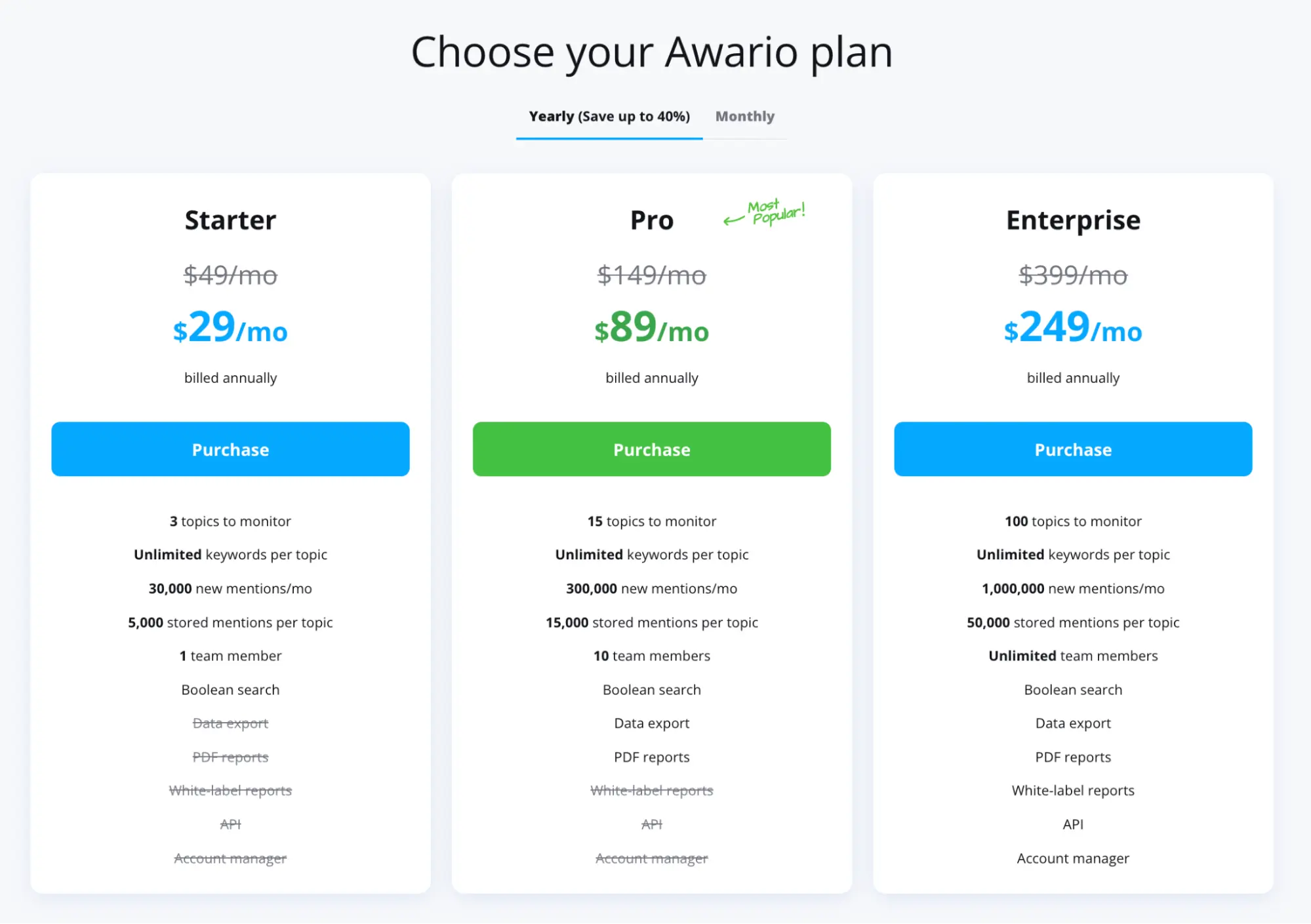
Limitations: Mention caps can cut coverage at inopportune moments, since collection pauses when a per-alert limit is hit. Sentiment accuracy has real limits, TikTok coverage is notably missing, API access is gated to the top tier, and cancellation requires contacting support directly, with no refunds for unused time.
14. BERA.ai
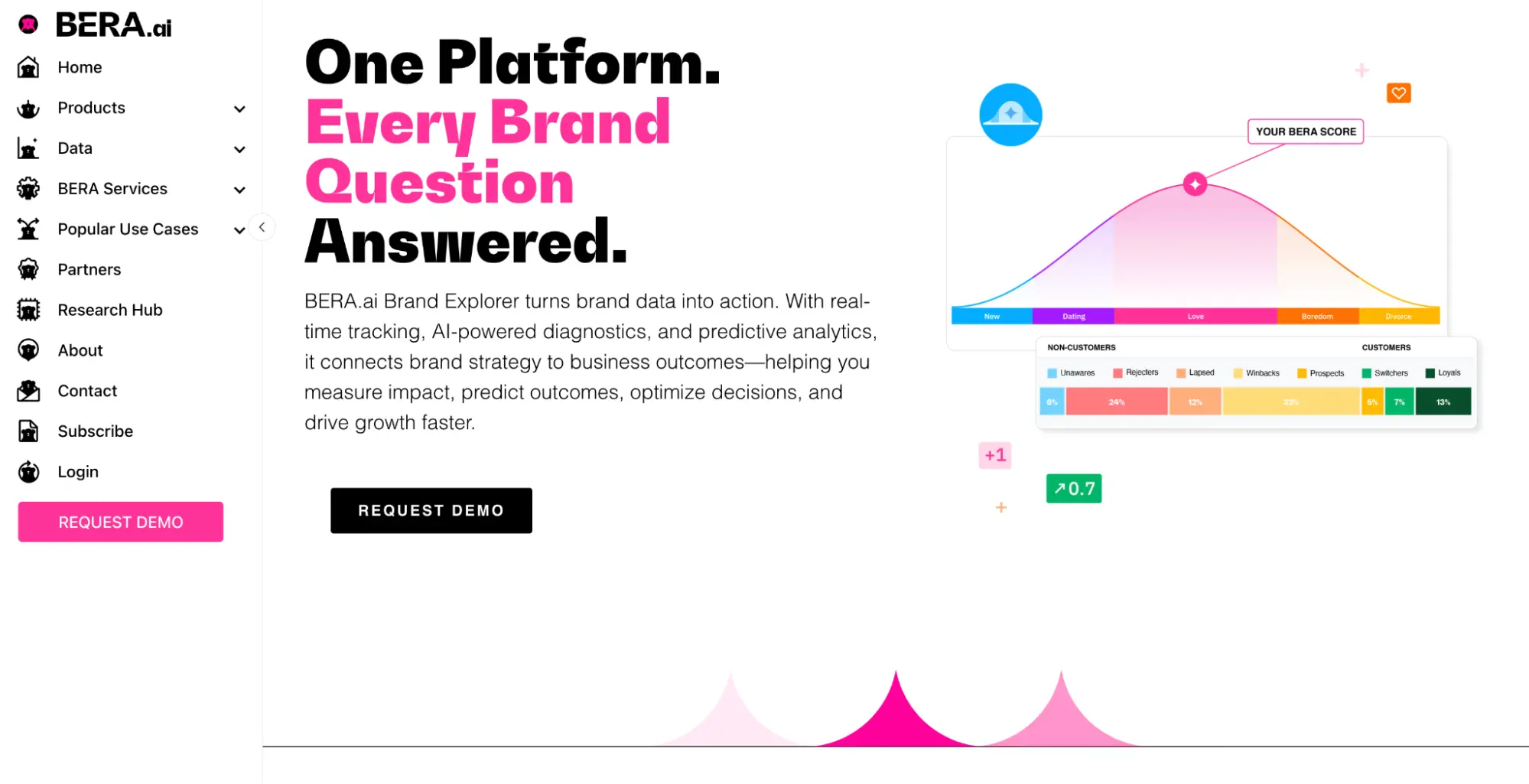
BERA.ai is a brand equity intelligence platform that connects brand perception to business outcomes, tracking more than 130 metrics across thousands of brands in 200-plus sectors using AI, census-matched panel data, predictive analytics, and always-on tracking with heavy expert advisory support.
BERA is more analyst-dependent and less plug-and-play than its marketing suggests. G2 reviewers report that data transfer to internal platforms is manual and error-prone, and that it's difficult to derive a standard brand funnel from BERA's data, in part because "the KPIs are not always as straightforward as brand awareness."
Best for: Enterprise CMO and finance teams that want to tie brand equity to financial outcomes (media mix modeling, investor reporting) and value expert advisory support over self-serve simplicity.
Pricing: No public pricin; demo and quote-only, subscription-based with multi-year enterprise contracts, and no free trial.
Limitations: There's a steep methodology learning curve, since BERA's KPIs aren't the familiar awareness/consideration funnel, so stakeholder education is required. Data export and integration is a weak point, with reviewers reporting manual, error-prone transfers. There's no self-serve option, no free trial, and it's an enterprise-only commitment.
15. Sprout Social
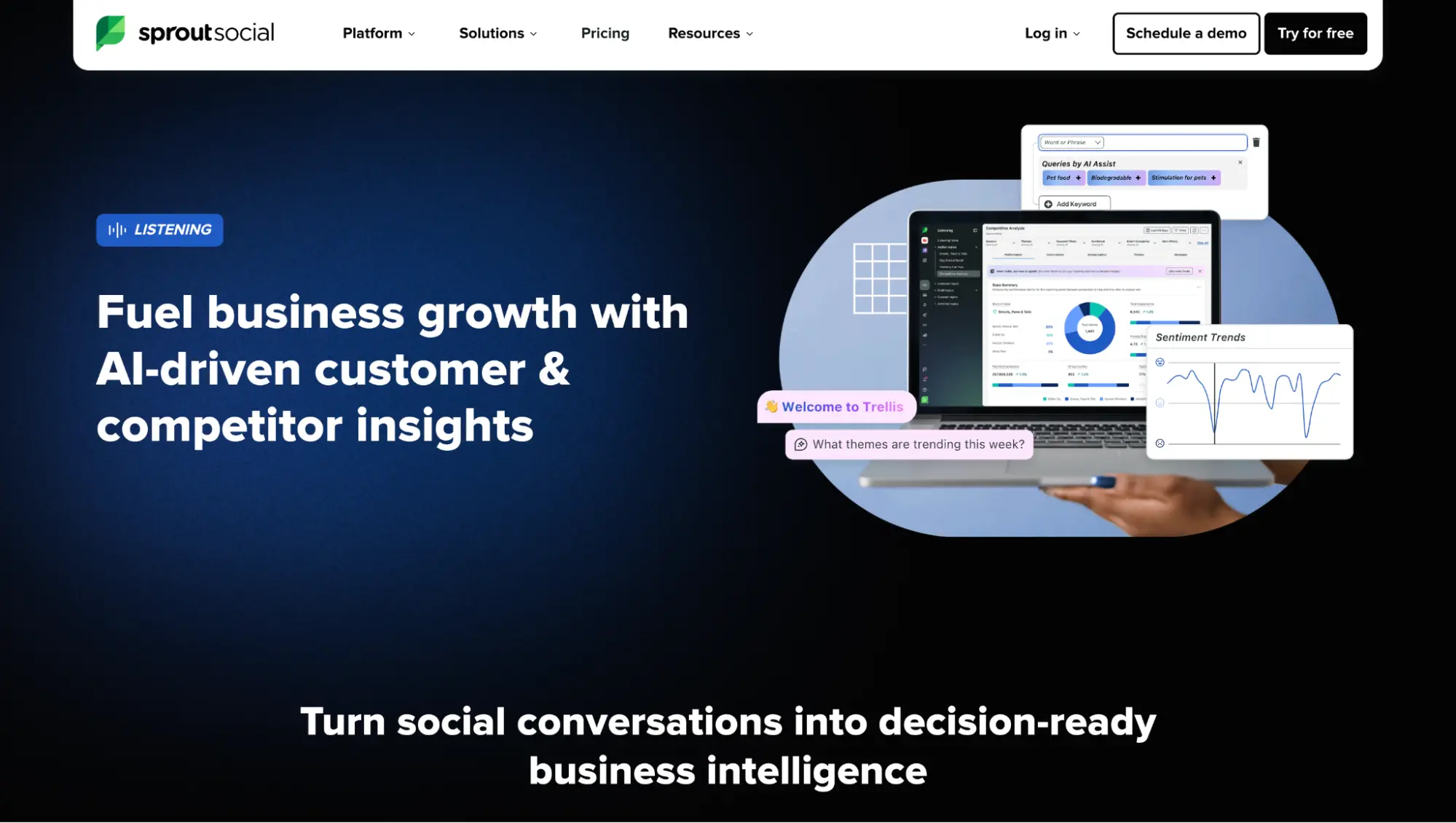
Sprout Social is an enterprise social media management platform used by more than 30,000 organizations, with social listening as one module inside a broader publishing, engagement, and analytics suite.
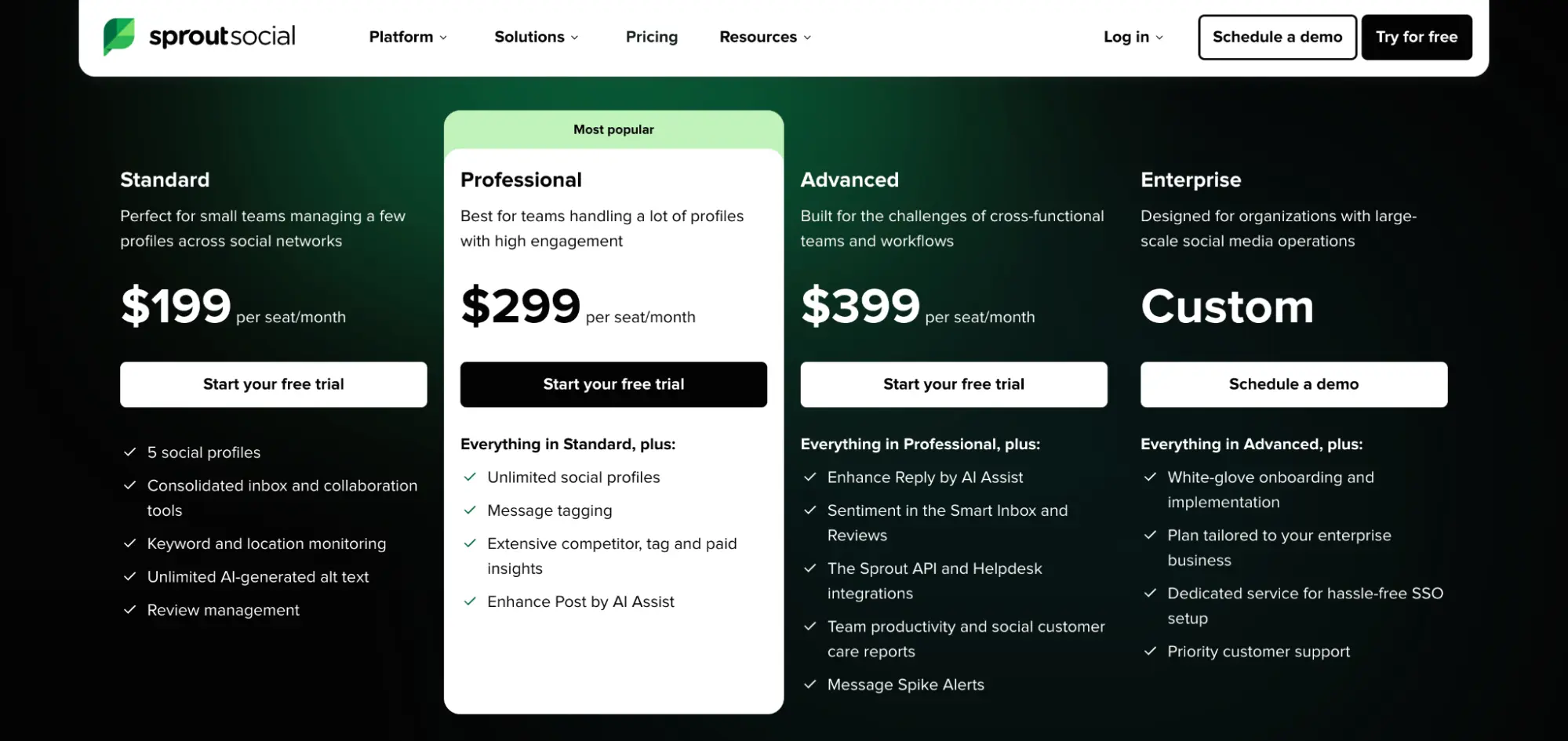
That said, listening isn't included by default, and that catches buyers off guard. The Standard plan at $199/user/month doesn't include social listening at all; you need at least the Professional tier plus a separate Listening add-on, which Sprout prices on request but industry estimates put at roughly $1,000/month on top of seat costs. G2 reviewers consistently flag this as the platform's biggest gap between marketing and reality.
Best for: Mid-market and enterprise teams that want listening bundled into a broader publishing and engagement workflow rather than a standalone tool.
Pricing: Public tiers, billed annually (per Sprout Social's pricing page and Vendr's procurement data): Essentials $79/seat/mo, Standard $199/seat/mo, Professional $299/seat/mo, Advanced $399/seat/mo (the first tier with sentiment analysis included), and custom Enterprise pricing (which bundles listening by default). A 30-day free trial is available, no credit card required.
Limitations: Social listening and premium analytics are separately priced add-ons on every tier below Enterprise, so the advertised per-seat price understates real cost. Per-seat pricing compounds quickly for larger teams, and reviewers note ticket-based support can be slow outside US business hours.
Why Reddit is the missing layer in most brand tracking strategies
Most brand tracking stacks are good at measuring what brands broadcast, decent at measuring passive social media, and consistently weak on Reddit.
Brand24 has user-reported Reddit and forum gaps, Agorapulse can't reliably target specific subreddits, Determ's Reddit coverage is described as "patchy," and even Awario, which does cover Reddit, can't filter it by location.
The audience is too big to ignore
Reddit's Q1 2026 SEC filing reported 126.8 million daily active uniques (+17% YoY) and 493.1 million weekly active uniques (+23%).
Threadlytics' State of Reddit 2026 report, which also found Reddit's organic search traffic grew roughly 70% over the past year and more than 1,800% over the past three. People go there specifically for unfiltered, community-validated opinions.
Consumers trust it more
Reddit's 2026 Path to Purchase research found half of US shoppers verify AI-generated product recommendations by checking Reddit first, and one in four buy immediately after seeing a decision validated there.
That tracks with Reddit's own CES research. When given a choice between a Reddit recommendation, an expert review site, an influencer ad, or a brand's own page, 42% of internet users say a Reddit recommendation is the most influential, and 23% of recommendation posts lead consumers to brands they hadn't previously considered.
AI engines cite it more than almost anything else
Profound's analysis of 680M+ AI citations found Reddit drives roughly 21% of Google AI Overview citations (ahead of YouTube and Quora) and 46.5% on Perplexity; it's the second most-cited domain on ChatGPT, behind only Wikipedia.
Ahrefs independently put it at 19.6% on AI Overviews, and a separate Profound study cited in Threadlytics' report found Reddit ranked in the top three cited sources across every major AI platform it tracked.
These numbers move around, Semrush tracked ChatGPT's Reddit citation rate swinging from 60% to 10% in weeks, and Scrunch has found specialist sites still out-rank Reddit in categories like finance and travel, so treat any single number as directional rather than fixed.
What doesn't move is the underlying logic: AI citations drive people to Reddit, which generates more discussion, which AI systems then cite even more, a compounding dynamic that rewards brands who show up early.
The key takeaway
What gets said in a subreddit today can shape how your brand is discovered in an AI answer months from now, in a channel most teams aren't watching at all.
Capturing that upside takes purpose-built tooling: subreddit-level filtering, context-aware keyword monitoring, cross-community Share of Voice, and opportunity scoring to prioritize what's worth a response. That's the gap platforms like Threadlytics were built to close.
How to choose the right brand tracking software
The right choice comes down to one question: what do you actually need to know?
- If you're watching for real-time mentions and potential crises, a broad social listening platform like Brandwatch, Meltwater, or Brand24 gives you the speed you need.
- If visual content or hashtag-driven campaigns matter most to your category, tools like YouScan or Keyhole are built specifically for that.
- If you're trying to understand unfiltered community sentiment that's shaping both purchase decisions and AI search outputs, you need Reddit-specific intelligence, like Threadlytics.
A simple three-step framework can keep you from getting distracted by feature lists:
First, define the metrics you actually need to answer your team's questions. Second, identify which data sources those metrics live in. Only then, third, evaluate tools against those specific requirements, not the other way around.
Too many teams reverse this order, falling in love with a dashboard before they've even defined what success looks like, or signing a contract before checking the fine print on renewal terms.
Also, the strongest brand tracking programs rarely rely on a single platform. They layer tools, a survey platform for long-term trend data, a monitoring tool for real-time alerts, and a community intelligence tool for the Reddit layer most stacks still miss.
Before you sign a contract with any vendor, audit your current stack for gaps. Given how much of brand discovery is now routed through AI answers that lean heavily on Reddit, there's a good chance that's one of them.
If you're ready to close that gap, Threadlytics' brand monitoring covers mention tracking, sentiment analysis, opportunity scoring, and Share of Voice analysis, purpose-built for the platform where your customers are talking the most candidly.

.svg)


.svg)

© Threadlytics 2026